
Performance Loss Usually Starts Before Failure
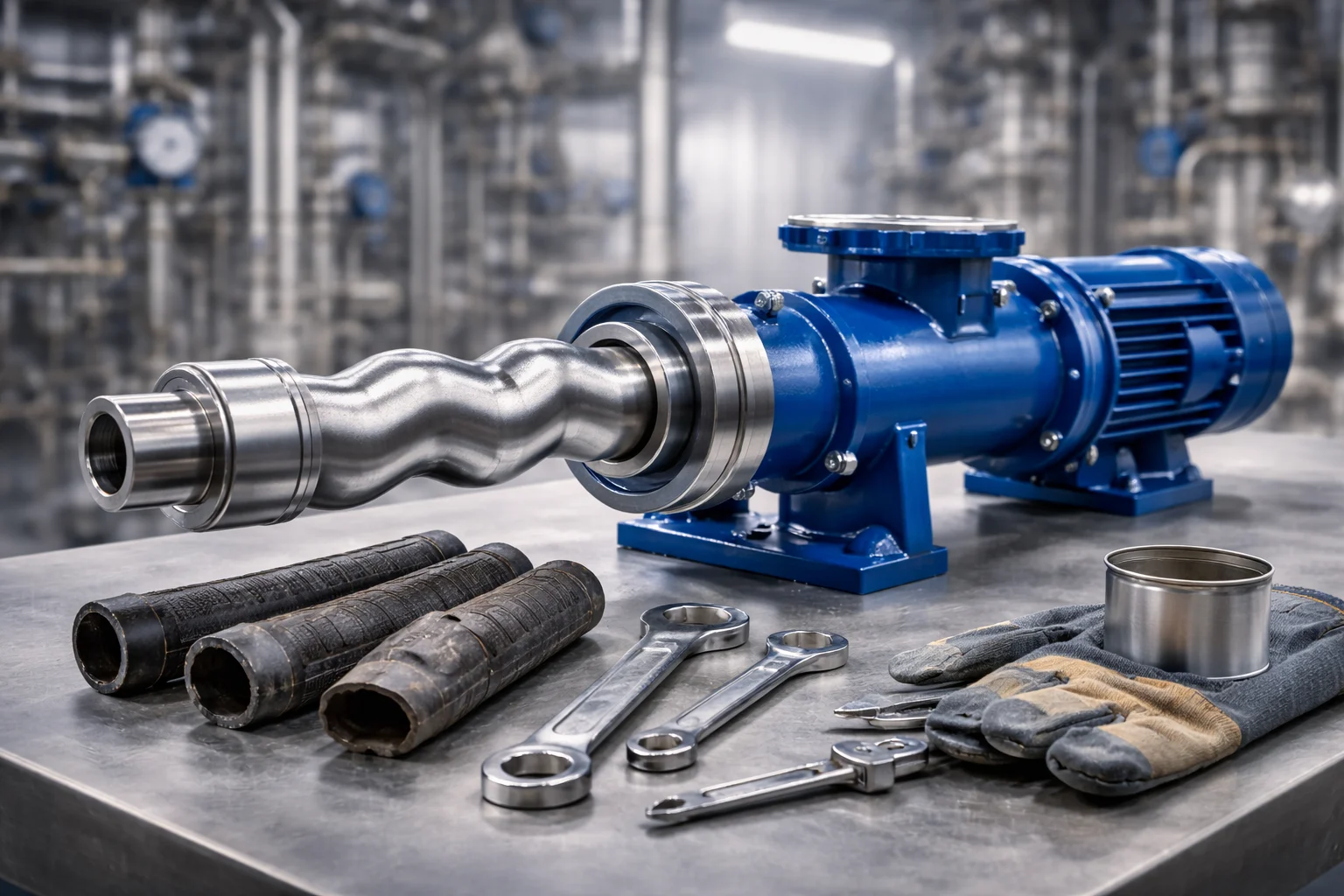
When you specify a progressive cavity pump for sludge, slurry, chemical liquid, food product, or other viscous media, stable flow is only one part of the requirement. You also need to think about suction behaviour, wear rate, solids handling, and how performance will change over time. In real operation, pump failures rarely start suddenly. It usually begins with gradual capacity loss, increased slip, unstable suction, higher torque demand, or shorter maintenance intervals. By the time the pump stops meeting process demand, internal wear has often been developing for some time.
Operating Conditions Cause Wear
In most cases, premature wear is caused by process conditions rather than age alone. With a progressive cavity pump in Malaysia, common contributors include abrasive solids, excessive differential pressure, dry running, poor lubrication from the pumped media, gas entrainment, and incorrect speed selection. Rotor and stator wear are usually the first indicators that something in the duty has been underestimated. Once the sealing line between rotor and stator begins to degrade, volumetric efficiency falls, and the pump has to work harder to maintain output. That usually leads to a cycle of reduced performance, higher wear, and more frequent intervention.
Suction Conditions Often Determine Service Life
When we review pump performance issues, suction conditions are often the first place to look. A progressive cavity pump depends on stable chamber filling. If suction lift is too high, pipe losses are excessive, or the fluid contains entrained air, the cavities do not fill consistently. The result can be cavitation, intermittent flow, poor efficiency, and accelerated wear across the rotor, stator, and mechanical seal arrangement.
This matters even more in viscous or solid-laden service. Thick media do not always flow cleanly into the suction housing, especially if line sizing is too small or the inlet arrangement creates a restriction. In these cases, the pump may appear correctly sized on paper but still underperform in operation because the hydraulic conditions at the suction side were not included in the design basis.
Prevention Depends On More Than Initial Sizing
A progressive cavity pump in Malaysia should not be selected on flow and pressure alone. You need to confirm actual viscosity at operating temperature, solids content, particle behaviour, suction layout, material compatibility, and expected run hours. These factors affect not only pump performance, but also stator life, rotor condition, seal reliability, and maintenance frequency.
Preventing premature wear also depends on operating discipline. Speed needs to match the fluid condition. Alignment needs to stay within tolerance. Lubrication and inspection intervals need to reflect the actual duty, not only the standard maintenance schedule. Spare parts strategy matters as well. When wear components are not available at the right time, a repairable problem quickly becomes a production issue.
Lifecycle Cost Is Usually A Downtime Issue
The lowest purchase price rarely gives the lowest total cost of ownership. In most services, the real cost comes from lost production during stator replacement, rotor wear, seal failure, or troubleshooting after a drop in flow. A progressive cavity pump has its wear and tear, so maintainability has to be part of the specification from the start. That means looking at service access, parts availability, refurbishment options, and how quickly the site can recover when performance begins to fall. For critical duties, those factors often matter more than the initial equipment cost.
Why Work With Us At Thermac Engineering
When you work with us, you get support built around duty, reliability, and long-term maintainability:
- We help you review pump curves, efficiency, material compatibility, and operating conditions before final selection.
- We consider future expansion and increased flow requirements, so your pump remains suitable as plant demand changes.
- We keep essential PCP spare parts, such as stators, rotors, joint seals, and mechanical seals, to reduce downtime during repairs.
- We support spare parts and retrofitting for various PCP makes, helping you maintain installed equipment across different brands.
- We provide pump parts replacement, refurbishment, disassembly, inspection, and servicing support when wear begins to affect performance.
- We support customers from Malaysia, with added regional coverage through Singapore and Thailand.
Choose us at Thermac Engineering when you need a progressive cavity pump in Malaysia, backed by practical engineering review, faster maintenance support, and service capabilities that fit real plant conditions.