
Why Compact Heat Transfer Still Needs Engineering Discipline
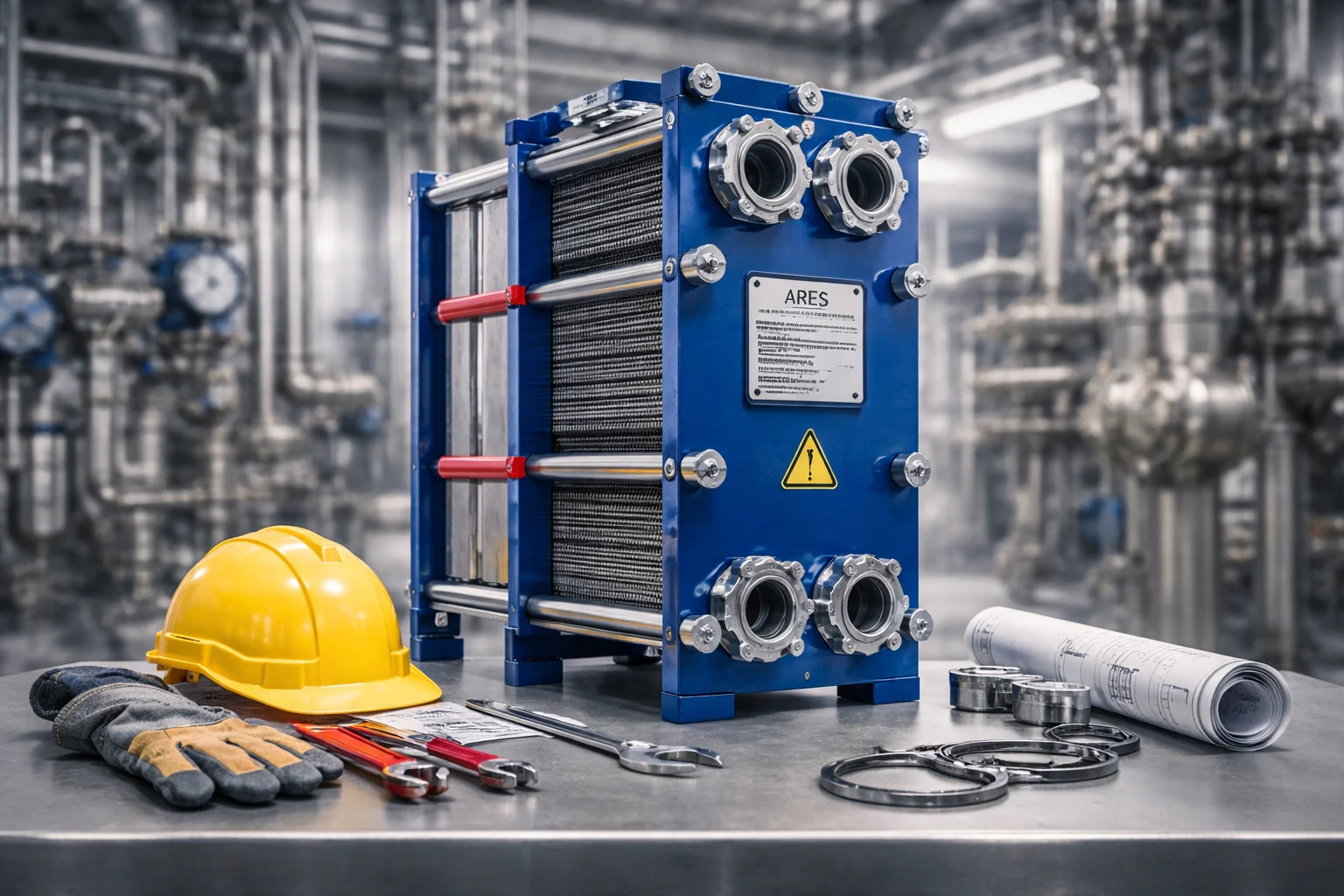
When we specify thermal equipment for a plant, the decision is not only about duty. We also need to consider pressure drop, approach temperature, fouling tendency, maintenance access, and whether the unit can be adapted to changing production. A plate heat exchanger is often preferred because corrugated plates create high turbulence and a large surface area in a relatively small footprint, allowing strong thermal performance without the space penalty normally associated with larger shell-and-tube layouts. Thermac Engineering frame-and-plate designs feature stacked gasketed plates and a frame arrangement designed for stability and service access.
Why Plants Focus on Serviceability, Not Just Nameplate Duty
For operating plants, serviceability is usually where the real value appears. Thermal performance can look acceptable on paper, but lifecycle costs increase quickly when cleaning takes too long, plates are difficult to access, or expansion requires full equipment replacement. At Thermac Engineering, we position our ARES range around removable plates, straightforward cleaning, reconfiguration, and lower downtime during maintenance. This means that the full heat transfer area can be reached by loosening the bolts, and that additional plates can be added when duty increases within frame limits. For plants planning debottlenecking or staged capacity expansion, that flexibility matters more than a low initial price.
Why ARES Fits Industrial Duty
An industrial plate heat exchanger must handle more than just clean utility water. In real service, contamination, gasket exposure, product safety, and media separation risk need to be accounted for. Our Thermac Engineering ARES range includes AWG wide-gap plates for more viscous fluids, ASW semi-welded plates that reduce gasket exposure on one side, and ADP double-wall plates for duties where media mixing is unacceptable. This allows our exchangers to be applicable across HVAC, power generation, oil and gas, edible oil processing, pharmaceutical service, food and beverage, and transformer oil cooling. That range of plate construction is important because the correct geometry and sealing arrangement often determine whether the exchanger remains stable between shutdowns.
What Needs To Be Checked Before Finalising A Plate Package
When we evaluate a plate heat exchanger in Malaysia, the technical review should start with process conditions, not catalogue size. We need confirmed duty, design and operating temperatures, allowable pressure drop, flow pattern, fluid chemistry, solids content, and cleaning method. We should also check nozzle orientation, pull space, tie-bolt access, and whether future expansion is expected. At Thermac Engineering, we offer a full range of services, including consultation, thermodynamic calculations, materials compatibility review, and equipment selection using our own programs, while also considering future production increases that may require additional plates. That is the right approach for plants where exchanger performance affects production continuity, energy use, and maintenance planning.
Why Malaysian Plants Keep Moving to Plate Heat Exchanger
The attraction of an ARES plate heat exchanger is not only compactness. It is the combination of a high heat transfer coefficient, reduced maintenance downtime, and modularity in a single unit. At Thermac, our PHEs can require up to five times less space than shell-and-tube exchangers, while the turbulence created by the plate pattern improves heat transfer value and helps reduce fouling. In plants where floor area, shutdown windows, and service manpower are all constrained, those factors directly affect project economics. The exchanger is no longer just a heat-transfer device. It becomes part of uptime management, service planning, and future capacity.
Why Work With Us At Thermac Engineering
When you work with us, you get more than equipment supply:
- We help you review duty, thermodynamic requirements, material compatibility, and future expansion before selection, so the plate heat exchanger is sized for the actual plant conditions, not just the current datasheet.
- We supply ARES systems with compact, expandable, and serviceable designs, including wide-gap, semi-welded, and double-wall options for more demanding duties.
- We support on-site maintenance, comprehensive servicing, UV inspection, and chemical cleaning to keep your exchanger operating efficiently.
- We keep spare parts and replacement units for various manufacturers, which helps you reduce downtime during urgent servicing or preventive maintenance.
- We support you from Malaysia, with additional offices in Singapore and Thailand for wider regional coverage.
Choose Thermac Engineering when you need a heat exchanger solution that is compact, maintainable, expandable, and backed by engineering support that matches real plant operating conditions.