
Why Precision Dosing Starts With Process Data
When we size a dosing pump for an industrial system, we do not start with capacity alone. We start with the process itself: required flow, discharge pressure, chemical concentration, suction condition, temperature, viscosity, and allowable dosing error. Metering pumps are positive-displacement pumps, so each stroke moves a defined volume. That is what makes them suitable for controlled injection in water treatment, petrochemical, and food processing systems. The real engineering work is making sure stroke volume, control method, and wetted materials stay stable under actual plant conditions, not only in a catalogue calculation.
When A Chemical Dosing Pump Is the Better Fit
We usually specify a chemical dosing pump when the application requires accurate injection of corrosive, hazardous, or reactive liquids into a pressurised line or process vessel. In these duties, repeatability matters as much as flow rate. You need to look at dosing range, back pressure, chemical compatibility, and whether the process requires manual adjustment, pulse-based control, or analogue input from a PLC. Our Thermac Engineering metering pump range includes solenoid-driven and motor-driven options, with capacities from 1 to 6,000 LPH and control options that include 4-20 mA, pulse, relay signal, and manual adjustment. That makes the selection step more about process control strategy than about pump size alone.
When To Specify A Diaphragm Dosing Pump
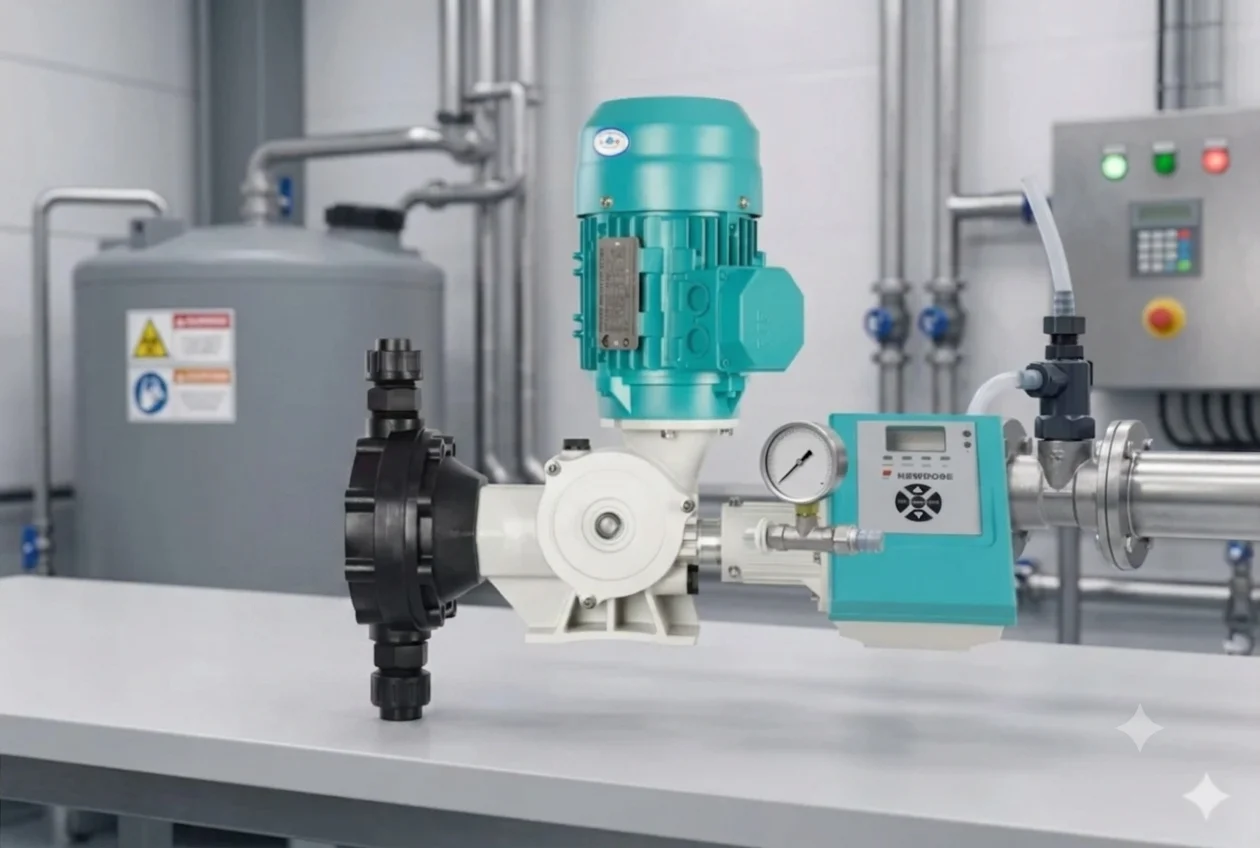
A diaphragm dosing pump is the preferred choice when isolating the liquid from the drive mechanism is important. Because the diaphragm creates the pumping action without allowing the process fluid to contact the internal mechanism, this design is better suited for aggressive chemicals, slurry service, and liquids that would otherwise create seal or plunger reliability issues. It is also a practical choice where low leakage risk and stable metering performance are part of the specification. In this type of service, diaphragm material, valve performance, gas release behaviour, and suction piping layout all affect dosing stability. Thermac Engineering pumps use a pure PTFE diaphragm which is relevant when long diaphragm life and chemical resistance are part of the selection criteria.
Control, Installation, And Maintenance Considerations
A dosing pump should be evaluated as part of the whole dosing skid, not as an isolated item. Things to check include the calibration method, pulsation effects, injection quill arrangement, suction line losses, degassing risk, and whether the process requires flow verification or only commanded stroke control. In some systems, poor suction conditions or gas locking will cause greater accuracy loss than the pump design itself. Mechanical details also matter. A compact structure can simplify installation where space is limited, while a common valve design across multiple models can reduce spare parts complexity. We at Thermac Engineering provide consultation, design support, pump curves, efficiency review, material compatibility checks, and equipment selection based on current duty and future expansion requirements.
Why Work With Us At Thermac Engineering
When you choose us for your dosing pump requirements, you get engineering support that is tied to application conditions, not just nameplate data:
- We help you review duty, pump curves, material compatibility, and control requirements before equipment is selected.
- We supply solenoid-driven and motor-driven metering pumps with capacities from 1 to 6,000 LPH so that we can support both low-rate chemical injection and higher-capacity dosing duties.
- We offer compact designs, simplified adjustment, and variable control via 4-20 mA, pulse, relay signal, or manual operation to suit the plant’s control philosophy.
- We support inspection, troubleshooting, pump parts replacement, refurbishment, and servicing contracts to help you manage reliability after installation.
- We back our metering range with a pure PTFE diaphragm design and a stated for long service life.
- We operate from Malaysia, with additional offices in Singapore and Thailand, providing stronger regional support for projects and service follow-up.
If you need a chemical or diaphragm dosing pump that is properly specified, controllable in operation, and supported after commissioning, work with us at Thermac Engineering.