
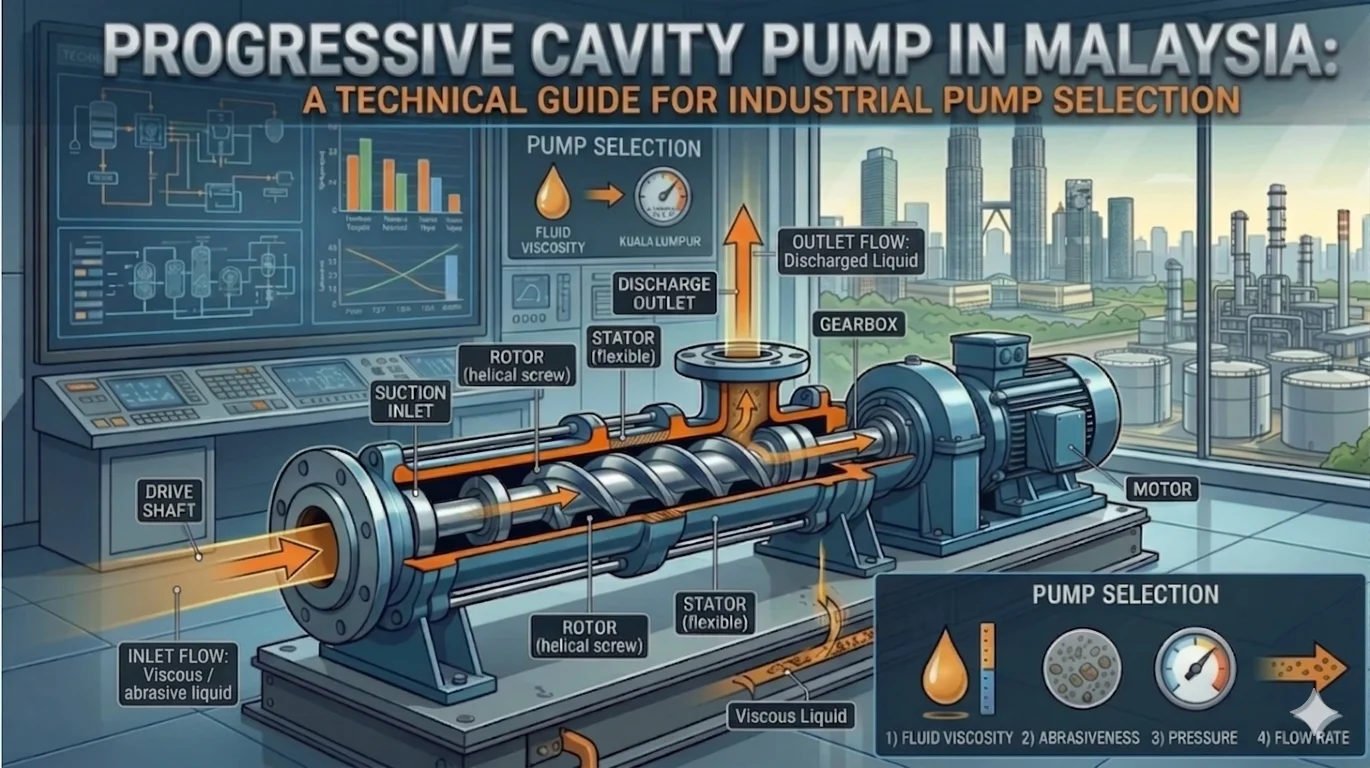
Why Selection Starts With Fluid Behaviour
For sludge transfer, polymer feed, chemical dosing, and other high-viscosity duties, pump selection should begin with the behaviour of the fluid under actual operating conditions. A progressive cavity pump is often used in these services because it delivers near-constant flow through sealed cavities formed between the rotor and stator. That operating principle makes it suitable for viscous, shear-sensitive, solids-laden, or non-homogeneous media where centrifugal pumps may lose performance or create unstable flow. For engineers, the benefit is not only transfer capability, but predictable output across a wide operating range when the pump is properly matched to the duty.
What Process Engineers Should Review First
Before selecting a unit, confirm the process data in full. Flow rate and discharge pressure are only the starting point. Viscosity at operating temperature, solids concentration, particle size, abrasiveness, suction lift, vapour pressure, and intermittent versus continuous duty all affect final selection. When evaluating a progressive cavity pump in Malaysia, local operating conditions also matter. Ambient heat, maintenance accessibility, spare-parts planning, and elastomer compatibility with process chemicals can all influence service life. Ignoring these factors often leads to premature stator wear, poor volumetric efficiency, or unstable suction performance.
Construction Type Must Match The Application
Pump configuration should be selected according to how the media enters, moves through, and leaves the system. Standard close-coupled designs are useful when the installation footprint is limited, and the process fluid can be pumped without assisted feeding. Bearing pedestal units are generally preferred where shaft loading, higher pressure, or longer operating hours require more robust mechanical support. Hopper-fed versions are more suitable for dewatered sludge, cake, pastes, and other media that will not flow consistently into a standard suction casing. Hygienic versions are required when cleanability, surface finish, and material compliance are specified. Vertical arrangements also have value where tank extraction or pit transfer creates difficult suction conditions.
Key Performance Limits To Check
A progressive cavity pump should never be selected based solely on catalogue capacity. Rotor and stator geometry determine the pressure generated per stage, but actual performance depends on slip, wear conditions, fluid lubricity, and suction stability. Engineers should verify differential pressure, net positive suction head requirements, solids handling capability, maximum temperature, and acceptable dry-run exposure. Speed control is another critical point. Running too fast can reduce fill efficiency and accelerate wear, especially with viscous or abrasive fluids. Running too slowly can affect throughput where process continuity is required. In many installations, variable speed control is not optional but necessary for process stability and equipment protection.
Look At Service Life, Not Only Purchase Price
The lowest capital cost rarely gives the lowest operating cost. A progressive cavity pump is a wear-component machine, so lifecycle performance depends heavily on stator life, rotor condition, joint integrity, seal selection, and operating conditions. Dry running, excessive suction lift, gas entrainment, and mismatched elastomers usually damage reliability faster than the process itself. For that reason, maintenance teams should review expected wear rates, ease of parts replacement, standby strategy, and the availability of critical spares before finalising procurement. This is especially important in wastewater, edible oil, chemical, and process manufacturing plants, where unplanned stoppages affect upstream and downstream equipment.
Why Choose Thermac Engineering
When you work with us at Thermac Engineering, you get support based on operating duty, not just nameplate data:
- We assist with consultation, pump selection, material compatibility review, and application-based sizing.
- We support spare parts and retrofitting for various makes, helping sites maintain installed equipment without being locked into one original manufacturer.
- We provide pump refurbishment, parts replacement, and maintenance support for wear-related service requirements.
- We stock essential PCP spare components, including stators, rotors, joint seals, and mechanical seals, to support faster turnaround.
- We serve industrial users from Malaysia, with added regional support through Singapore and Thailand.
For plants that need a progressive cavity pump in Malaysia with proper engineering review, service support, and long-term maintainability, Thermac Engineering gives you a technically grounded solution backed by practical field support.