
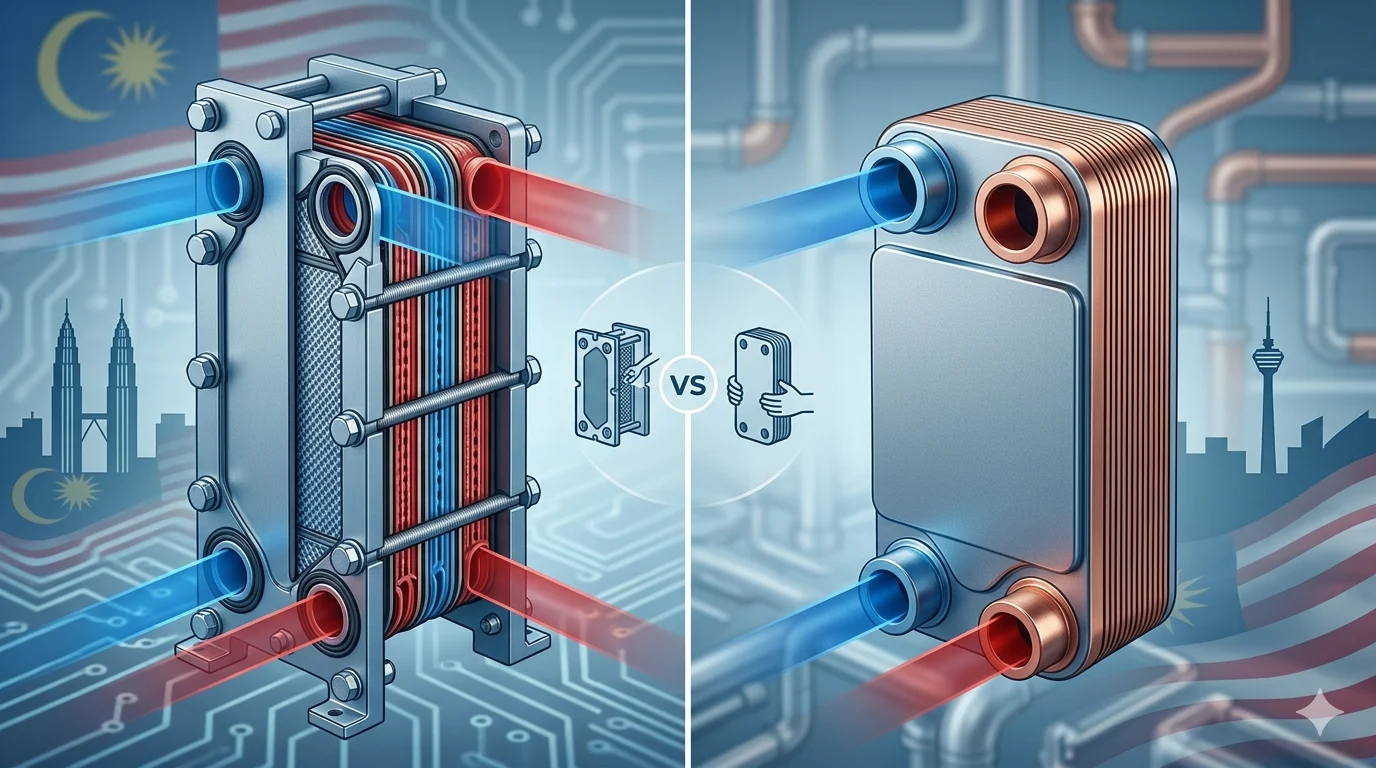
For process engineers and maintenance teams, exchanger selection affects more than installed cost. It influences thermal efficiency, allowable pressure drop, cleanability, standby planning, maintenance intervals, and lifecycle performance. A plate heat exchanger is widely used because it provides high heat transfer coefficients through corrugated plates and true counter-current flow, while keeping footprint and hold-up volume relatively low.
In industrial service, this matters when tighter approach temperatures are required without committing to a larger shell-and-tube footprint. Plate geometry also gives designers greater flexibility when duty cycles change over time. Capacity can often be adjusted by changing the plate pack, provided the frame and hydraulic limits are suitable. For plants that expect production debottlenecking, process variation, or staged expansion, that flexibility is often part of the specification rather than an afterthought.
Gasketed vs Brazed: What Changes in Practice
The selection usually comes down to a gasketed unit or a brazed plate heat exchanger. The difference is not only construction. It affects inspection access, maintenance strategy, fluid compatibility, and how the exchanger behaves in real operating conditions.
A gasketed unit is generally selected when fouling is expected, when solids or fibrous material may be present, or when periodic inspection openings are part of the maintenance plan. It is also the better option when duty may increase later, because plates can be added or rearranged within design limits. In applications with CIP requirements, frequent shutdown cleaning, or uncertainty about fouling rates, this design gives operations and maintenance teams greater control.
A brazed unit is more suitable for closed-loop, relatively clean duties where compactness and low routine maintenance are priorities. Because it has no gaskets and no frame-opening requirements, it is commonly used in HVAC, refrigeration, heat recovery, and utility systems. The trade-off is serviceability. Once fouling, scaling, or internal blockage occurs beyond what chemical cleaning can address, replacement may be more practical than overhaul.
What Industry Professionals Should Evaluate
When specifying a plate heat exchanger in Malaysia, the correct starting point is process data. Confirm thermal duty, design and operating temperatures, flow rates, fluid composition, viscosity, allowable pressure drop, and fouling tendency. Then check material compatibility. Plate and gasket selection must reflect, cleaning chemicals, temperature cycling, and the actual process media, not only the normal operating case.
Mechanical considerations are equally important. Review design pressure, upset conditions, start-stop frequency, connection arrangement, and maintenance access. In brownfield plants, nozzle orientation, pipe stress, and available pull space can determine whether a technically correct selection is practical to install and service. Engineers should also look at redundancy philosophy. If the exchanger supports critical cooling or production continuity, the maintenance approach should be decided at the same time as the equipment type.
Look Beyond Purchase Price
The lowest purchase price rarely gives the lowest operating cost. A compact sealed unit may reduce space requirements and simplify installation, but a serviceable plate heat exchanger may lower cost over time where fouling, frequent cleaning, or future duty changes are expected. The right decision depends on duty stability, water quality, cleaning method, shutdown windows, and spare parts strategy. Selection should be based on total operating context, not only nameplate performance.
Why Choose Thermac Engineering
At Thermac Engineering, we support your project with the technical and service scope required for long-term plant operation:
- We provide consultation, equipment selection, and design support tailored to your duty, operating conditions, and service requirements.
- We support maintenance, repair, cleaning, inspection, and troubleshooting to help restore thermal performance and reduce unplanned downtime.
- We supply spare parts and retrofit support for various makes, which is critical when installed equipment is no longer limited to one brand.
- We provide on-site service capability for plants that need inspection, servicing, or corrective work without extended equipment removal.
- We serve industrial users from Malaysia, with additional regional support through Singapore and Thailand.
- We work across HVAC, district cooling, power, oil and gas, food and beverage, pharmaceutical, and other process industries where exchanger reliability directly affects output.
If you are selecting a new plate heat exchanger in Malaysia, replacing an underperforming unit, or planning maintenance on an existing system, speak to Thermac Engineering for application-based recommendations and service support that align with plant operating realities