
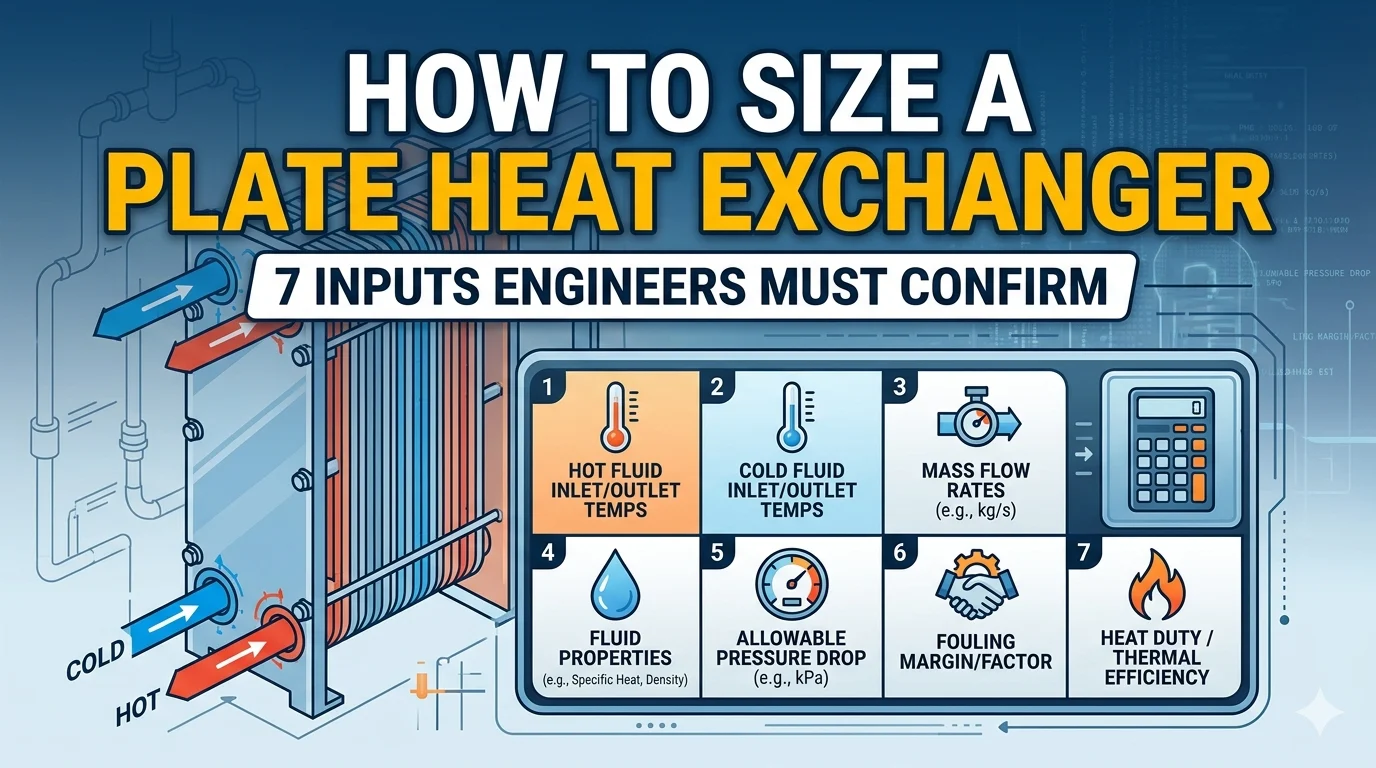
When a thermal loop misses its outlet temperature, the root cause is often not “bad equipment” but unclear design data. Sizing starts with the heat balance, then moves to hydraulics, then to materials and maintainability. Do that in the right order, and a plate heat exchanger becomes a predictable, controllable piece of plant hardware instead of a troubleshooting project.
Here’s the recommended seven-input checklist to go through before you ask any vendor for a selection. You can treat it as an RFQ cover sheet.
1. Heat Duty
Finding the required Q and operating range. Validate with a quick energy check. For single-phase fluids, Q ≈ m·Cp·ΔT. If the stated duty conflicts with the flow and temperature change, fix that first.
2. Temperatures
What are the hot/cold inlets, the target outlets, and the normal/min/max? Include realistic ranges. Tight approaches are achievable, but they can drive a larger surface area and tighter hydraulic margins.
3. Flow Rates
Normal plus turndown (min/max) on both sides. Don’t size only for “nameplate.” If your loop runs at 40–100% flow, the design must be stable across that envelope.
4. Allowable Pressure Drop
Maximum pressure drop per side at normal flow. Declare it early. ΔP is not a nuisance number; it sets channel velocity, pass arrangement, and whether you end up with a compact unit or a pump problem. This is where an industrial plate heat exchanger design is won or lost.
5. Fluid Properties
Viscosity, density, Cp, solids/gas, phase behavior. If viscosity climbs with cooling, if there’s entrained air, or if solids load varies, say so. These details shift heat transfer coefficients and fouling risk.
6. Fouling And Cleaning
Fouling expectation, CIP, or opening frequency. Be honest about your maintenance reality. If you rely on periodic opening, you want an arrangement that can be safely de-bolted and reassembled without plate damage; if you rely on CIP, gasket compatibility matters as much as thermal performance.
7. Limits And Materials
Design P/T, metallurgy, gasket elastomer constraints. Specify design pressure and temperature, along with any chlorides, acids, oils, or solvents that affect plate metallurgy and gasket selection. If you’re unsure, ask for a compatibility review rather than guessing. This is also where our ARES plate heat exchanger can be configured for your exact duty and future expansion, because plate packs are modular and can be adapted when operating conditions change.
Once you supply these seven inputs, you can compare proposals on equal terms: plate count, expected approach, predicted ΔP at duty, and the assumptions behind the fouling factor. If a quote looks “too good,” challenge the assumptions, not the brand. It’s normal to request a datasheet that states predicted thermal performance and hydraulic losses at your normal operating point.
Why Thermac Engineering Is The Premier Choice
Want a selection you can defend to operations? We can help you turn your process sheet into a clear specification and a fast, defensible quotation with clear documentation for a plate heat exchanger in Malaysia. At Thermac Engineering, our team of experienced professionals offers free consultation, uses selection tools to match duty and ΔP, and provides expansion plans upfront.
We also support on-site maintenance, comprehensive servicing and repair (including inspection and chemical cleaning), and ready spare parts for multiple brands, so you get a solution you can run, service, and scale.